
Play and outdoor education
Partners and Faculty
FREE GAME UNIVERSITY
The Free University of Play Association APS (LUnGi) carries out activities for the benefit of its members as well as for third parties, promoting initiatives on issues related to the many facets of play, its culture and the experience of play understood as a fundamental experience in the formation of the person and as an indicator of quality of life.
Based on the principle of the “right to play,” affirmed in Article 31 of the UN Convention on the Rights of the Child and Adolescent, the association is committed to affirming and promoting the multicultural, inclusive and non-discriminatory nature of play.
The Association also aims to combat forms of ludopathy by promoting both knowledge of the risks and conditions that foster their occurrence and prevention initiatives, and the spread of a healthy gaming culture that places the active and responsible individual at the center.

Roberto Farnè
+

Formerly a full professor in General Education, he is now an adjunct lecturer teaching “Pedagogy of Play and Sport” in the Bachelor of Arts in Physical Education, at the Department of Quality of Life Sciences. His fields of study and research mainly concern the relationship between education and media, pedagogy of play and sport, and outdoor education.
Leonardo Tedeschi
+
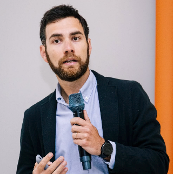
An architect since childhood, he has been trying not to lose that look, the desire to learn and experiment ever since. After graduating, he broadened his horizons with a master’s degree in social enterprise management to give structure, not only architectural but also organizational, to ideas and projects.
Over time he gained experience in the field working with public administrations, agencies and third sector realities, always balancing urban regeneration and social innovation. Since 2018 he has been working at the Rusconi Ghigi Urban Innovation Foundation, where he coordinates the Urban Space Transformation area, dealing with imagining and accompanying processes of change that bring into dialogue public space, environment and community.
In recent years, among other projects, he has overseen the evolution of school squares: born as experimental prototypes, they have become threshold spaces between the school and the city and important pieces in urban projects such as Città 30 and Bologna Verde.
RIVER PARK
Recently extended to 14 municipalities around Cuneo, with a total of about 5,500 hectares of land, 60 km of river and the same number of bicycle and pedestrian paths, the Gesso and Stura River Park represents a hinge connecting mountain and lowland areas.
The Park alternates between inhabited areas and productive settlements, areas used as urban gardens and places of natural environment populated by hundreds of animal species, some even of special conservation interest: 200 species of birds, 25 of mammals, 9 of amphibians, 8 of reptiles, 53 of butterflies, as well as a considerable number of insects and other invertebrates. The various river and perifluvial ecosystems represent a fundamental asset for environmental education, which is among the main objectives of the Authority and is aimed at making both children and adults aware of the richness and fragility inherent in natural environments.
Educational activities are distinguished by their interactive, experiential and interdisciplinary nature and address naturalistic and scientific issues including raising awareness of climate change.

Sara Ambrosoli & Paolo Cavallo
+
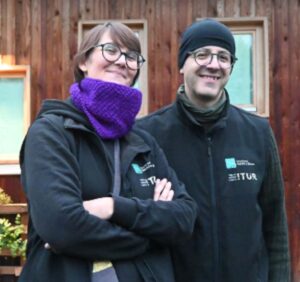
Environmental architects and coordinators of the Education and Events Team of the Gesso and Stura River Park (CN), we have been involved in environmental awareness activities and projects supporting experiential education for years.
We develop edutainment and urban and environmental regeneration projects, installations and exhibitions, educational and communication activities supporting experiential enjoyment with a special focus on scientific-environmental and sustainability issues.
Underlying our actions is a scientific background contaminated by many interests in humanities, economics and social disciplines that we transpose into interdisciplinary projects.